Monday, 23 May 2022

Londons Mayor Teeters on the Edge of Cannabis Legalization

TESTSTSARDSAR

London’s Mayor Teeters on the Edge of Cannabis Legalization by Marguerite Arnold

Sadiq Khan appointed a former member of Tony Blair’s cabinet and current Labour shadow cabinet member to examine cannabis decriminalization.

Sadiq Khan has been on a cannabis decriminalization kick for the past couple of years. He announced in April 2021 that he wanted to set up a commission to examine the impact of cannabis decriminalization.

In January of this year, he announced that he wanted to set up a decriminalization scheme in three London boroughs. This month, after visiting a cannabis farm in Los Angeles, he is moving forward with setting up his commission.

While City Hall in London does not have the power to change criminal law on a federal basis in the UK, it can certainly influence the debate.

Khan is particularly interested in two issues: producing income in the form of taxes for the state, and reducing cannabis-related arrests.

Arrests for cannabis dropped by 56% after California legalized the cultivation, production, and sale of the plant.

Could the UK Follow Switzerland and Germany?

Khan’s commission will take another year to study the issue – in part by conducting a global survey on the health impacts of decriminalizing the plant.

In the meantime, however, both Germany and Switzerland will be moving towards a full-blown recreational market.

In Switzerland, it is clear that the first step will be a highly limited, canton-by-canton trial that must first gain the approval of the federal government. In Germany, the indications are that the government will launch a fully functional market immediately.

By next year, when Khan’s commission reports back, there will be (at least) four recreational markets in Europe (counting Malta) and potentially five if Luxembourg also takes the opportunity of the changing environment to release their plans.

Holland’s national plan will kick in as of next year.

This is powerful evidence indeed – beyond of course the history of both Canada and the legalizing U.S. states.

The UK’s CBD Market May Also Provide a Model

The UK has actually moved ahead of many European states (including Germany) by allowing several thousand pre-approved CBD products onto the market.

This government-sanctioned commercialization of the CBD industry could also lead the UK to move forward with full legalization, particularly if other countries in Europe are also moving forward on legalizing recreational use.

No matter what happens, there will still be a period of consideration, regardless of what Khan and his commission decide. In the meantime, the UK will watch several markets in Europe begin to establish themselves, and potentially the U.S. as well.

One thing is for sure. The British are not leading this one.

This article was originally published on InternationalCannabisChronicle.com.

A link to your site, with your site's name and description as anchor text.


Via https://cannatechtoday.com/londons-mayor-teeters-on-the-edge-of-cannabis-legalization/


source https://renzverspaget.weebly.com/blog/londons-mayor-teeters-on-the-edge-of-cannabis-legalization

Friday, 20 May 2022

New CBD Safety Study Takes Aim at FDA Concerns

Recently published results from a 1,061-participant, two-cohort CBD safety study officially completed on March 22nd address three of the most common safety and long-term health concerns associated with the hemp-based compound.

The study—implemented by the study platform Validcare partnered with 17 CBD companies—was structured to provide pointed data directly responding to the FDA’s concerns about CBD and elevated liver enzymes, drowsiness, and lower testosterone levels in males. 

Here’s a summary of the key findings of the study—which recruited American participants from ages 18-75 to take CBD orally for at least 30 days—as reported by the U.S. Hemp Roundtable and the study itself:

Liver Function

At the end of the 30-day period, all participants were administered liver function tests (LFT). 

Per the study authors, “There was no significant association between CBD dosage and LT [liver test] values,” meaning that CBD did not negatively impact liver function as previous findings have suggested.

Notably, the baseline liver function of the participant pool was not significantly different from the general population, none of the participants had clinical liver disease, and CBD’s influence on liver function was not affected by product source or form. 

Testosterone

Men were administered both total testosterone (TT) and free testosterone (FT) tests at the end of the 30-day trial period to assess the effects, if any, that CBD had on these values.

Per the study authors, “There is a significant positive association between TT level and dose of CBD per weight (mg/kg).” 

Drowsiness

Finally, the majority of participants (914 out of 1,061) participated in baseline and weekly sleep assessments throughout the 30-day period, which were administered using the Stanford Sleep Scale.

The authors found that consistent CBD usage resulted in consistently lower scores on the scale, which means CBD was effective in promoting “daytime alertness and less drowsiness.” 

In light of these clearly identifiable data trends, the study authors concluded that CBD usage had no association with liver function impairment, testosterone deficiency or drowsiness during the day.

Considering the highly targeted (at the FDA) nature of the data and the size of the study, we will eagerly await the FDA’s response along with other industry watchers and report back to our audience as any developments unfold. 


via The CBD Insider https://thecbdinsider.com/news/cbd-safety-study-fda-concerns/#utm_source=rss&utm_medium=rss&utm_campaign=cbd-safety-study-fda-concerns


source https://renzverspaget.weebly.com/blog/new-cbd-safety-study-takes-aim-at-fda-concerns

Woody Wins a Willie After Launching Dispensary in Hollywood

TESTSTSARDSAR

Woody Wins a Willie After Launching Dispensary in Hollywood by Patricia Miller

What’s your favorite Woody Harrelson performance? He kept audiences on the edge of their seats in Natural Born Killers and Zombieland, he won the hearts of millions on Cheers and True Detective, and now the iconic actor is bringing even more excitement to Hollywood. Last Friday, Harrelson opened the doors on The Woods, his new West Hollywood cannabis dispensary. 

The artfully-designed dispensary is co-founded by comedian Bill Maher, ERBA founders Devon Wheeler and Jay Handal, Schoos Design CEO Michael Berman, and Creative Director Thomas Schoos.

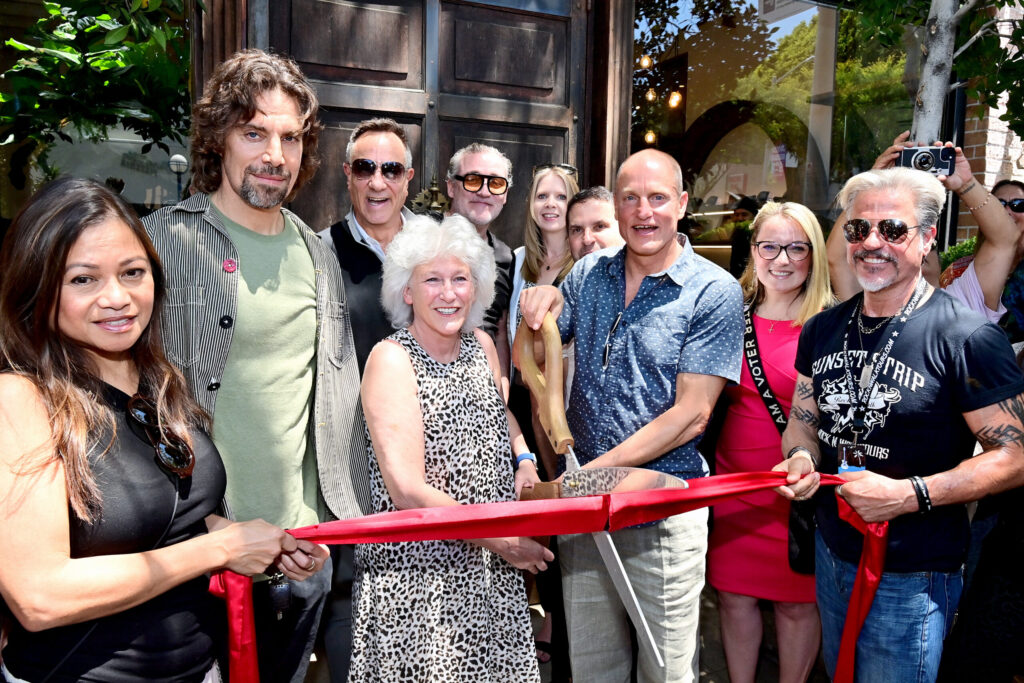
Mayor Lauren Meister, Chamber of Commerce President and CEO Genevieve Morrill, and throngs of enthusiastic shoppers attended the opening ceremony. 

(L-R) Mylena Christina, Devon Wheeler, Keith Kaplan, Mayor Lauren Meister, Thomas Schoos, Michael Berman, Woody Harrelson, Councilmember Lindsey Horvath, and Jon D’Amico cut the ribbon at ‘The Woods’ Opening Day on May 13, 2022 in West Hollywood, California. (Photo by Stefanie Keenan/Getty Images for The Woods)

“Thank you to the City of West Hollywood, Genevieve Morrill, and Laurie Meister. We are so excited to open our doors to the community,” Harrelson said during the ribbon cutting ceremony.

The Woods Is Born

The location was an artists’ studio for designer Thomas Schoos when Harrelson and Wheeler first visited years ago. It was there they decided the time was right for their idea to take shape and that Schoos would design the space to fit their vision. 

As eager attendees entered the newly opened space, they were greeted by warm, natural colors and high-end finishes well-suited to West Hollywood’s culture. “Our space is made of two distinct halves,” Schoos said. 

Guests attend ‘The Woods’ Opening Day on May 13, 2022 in West Hollywood, California. (Photo by Stefanie Keenan/Getty Images for The Woods)

“There is our freestanding neighborhood bar on the west side and our dispensary on the east side. Each half appeals to somewhat different crowds looking for the same good time,” Schoos added.

The Woods is emphasizing sungrown, organic flower and a return to the “legacy roots” of cannabis culture. 

An After Party to Remember

After the opening, select members of the cannabis industry and local community gathered at Norah, an upscale restaurant nearby. 

(L-R) Woody Harrelson, Orly Marley, and Ziggy Marley attend ‘The Woods’ Opening Day on May 13, 2022 in West Hollywood, California. (Photo by Stefanie Keenan/Getty Images for The Woods)

The local sheriff, the Fire Department, and other city officials mingled with high-profile attendees like Ziggy Marley, Bill Maher, and of course Harrelson himself. The intent was reportedly to “bridge the gap” between the community, the dispensary, and the individuals who protect it.

The gathering at Norah offered an open bar, hor’dourves, and an honorary cake cutting.

(L-R) Woody Harrelson, Bill Maher, Devon Wheeler, and Jay Handal attend ‘The Woods’ Opening Day on May 13, 2022 in West Hollywood, California. (Photo by Stefanie Keenan/Getty Images for The Woods)

More than just another dispensary, The Woods aims to become a community fixture, offering events such as comedy nights, spoken word poetry, product releases, education panels, and private parties.

“Our goal is essentially to return the legacy operators’ work to the forefront before it gets washed out by corporations. The Woods is all about getting back to basics with nature and cannabis,” Wheeler said.

Woody Wins a Willie for Advocacy

The same weekend Harrelson opened his dispensary, he was honored with the “Willie Nelson” award for a lifetime of cannabis advocacy at the Emerald Cup Awards

Harrelson advocated for the plant long before California legalized cannabis. He’s openly endorsed the healing properties of the herb for years. He famously protested cannabis criminalization by illegally planting hemp seeds in 1996. 

Harrelson is also a proponent of regenerative farming practices, which will be reflected in the products offered at The Woods dispensary.

Upon accepting the award, Harrelson reportedly said he hadn’t smoked cannabis in a long time, at least since 4:20 that afternoon.

Lead image courtesy Stefanie Keenan/Getty Images for The Woods

A link to your site, with your site's name and description as anchor text.


Via https://cannatechtoday.com/woody-harrelson-wins-willie-after-launching-dispensary/


source https://renzverspaget.weebly.com/blog/woody-wins-a-willie-after-launching-dispensary-in-hollywood

Thursday, 19 May 2022

The Critical Role of Technology in the Cannabis Industry

TESTSTSARDSAR

<strong>The Critical Role of Technology in the Cannabis Industry</strong> by Aron Vaughan

The cannabis industry has grown exponentially over the past few years, by any measure. 

It has experienced growth spurts, just like children do, and with them, the exuberance of puberty. Now, the industry has come to that point which we all inevitably reach when it comes time to choose to remain stuck in immaturity or to begin adulting.

We have seen the community change gradually. There are fewer and fewer “flakes” and more and more serious professionals. 

The fact is that unless we accept that we need to get real and professional, and “grow up” in our approach to this amazing industry, the fun will seep away as fines are levied, licenses are revoked, and the public loses confidence in the safety of cannabis products, and businesses fail.

It is becoming clear that transparent, conscientious growing and handling processes, validated test methods, certified laboratory testing, precision quality control, and accurate labeling must become the norm rather than the exception.

User-friendly, reliable, fair, and speedy payment and delivery must combine with these things to establish unquestionable trust and confidence in the cannabis industry.

Any who do not embrace these standards will inevitably fail – and take part of the industry’s credibility with it. Anyone who has been paying attention can see this is already the case.

How do we avoid that and build quality and trust in the industry? The answer, just as in many other industries, is technology.

So what are the areas where technology can help establish integrity and trust and thereby establish long term success and sustainability for both your business and the industry at large? 

Growers

The cannabis industry is growing, and the cannabis industry is about growing! The choices growers make affect availability, pricing, and quality all the way down the line, through distributors, retailers, and consumers.

If they get something wrong it has ripples. Equally, the things they get right also can improve the whole production and delivery process. Growers need to effectively control: quality, efficiency, and cost-effectiveness:

  • Seeds – Quality starts with the seeds. To be successful requires the best quality and good storage.
  • Cultivation – From there it’s about proper lighting and lighting duration, watering, fertilization, climate control, weeding, and pest and disease control. There are a lot of parameters to control in all of that, and getting the recipe right for each product, whether hemp, CBD or other cannabinoids, Indica or Sativa, and every strain and hybrid is a complex challenge.
  • End Product – The wide variety of products ranges from hemp rope to topicals, ingestibles of every description, whether nutraceuticals, medicinal, therapeutic or recreational, and inhalables. Each has its own important acceptable parameters of safety, effectiveness, usability and shelf life. 
  • Tracking – Every state that allows THC products also has a track-and-trace program in place, except, for the moment, Florida. States are able to keep federal scrutiny at bay by showing that they have a firm grasp on the whereabouts of every last gram. Growers must comply with those tracking and reporting requirements. This is not currently the case in Georgia of course, but it would be as well to be ready when that time comes.

Solutions

Growers use everything from low tech careful, diligent monitoring and manual note-taking of water usage, temperature, humidity, light and fertilization and their effect on the crops as they measure growth, potency, etc., to higher-tech solutions that can include:

  • Media Moisture Sensors
  • LED lighting
  • Anemometers
  • Fertigation systems
  • Smart Greenhouses, Buildings
  • Smart Systems
  • Data Tracking and Reporting Systems

Some Applications involved include:

  • Smart Phone Apps that can let you monitor and control multiple parameters of the growing environment remotely
  • Laboratory Information Management Systems (LIMS) – Although primarily designed to manage lab data, there are a couple of very flexible, versatile LIMS that can manage all of your metrics, schedules, alerts and record storage, and calculate trends in their central cloud database. The added benefit of these is they can generate a wide range of reports as well. And they can be set to trigger events that work together with other systems. More and more, this kind of comprehensive data management scheme is becoming the preferred way to manage what is a highly competitive and data-driven industry, in order to ensure long-term viability.

The Technologies employed include:

  • Blockchain – This technology supports cryptocurrency, which is leveraged in cases where federally insured banks aren’t an option, and that usage is spreading into other areas. It also is a great way to provide high levels of privacy and security, since data are dispersed with no single point of full access or gain-of-function.
  • Cloud – This is no surprise. Cloud tech has become the standard across industries. It’s cheap, reliable, secure and very convenient.
  • Artificial Intelligence – AI is kind of like cloud computing was a few years ago. It is the darling of developers and is starting to be applied to everything. The value of technology that learns and improves its performance the longer it is employed is obvious. If only all our employees did that… And maybe our elected leaders in DC and the states…
  • The Internet of Things (IOT) – Anyone who has bought a refrigerator recently may have been surprised to find they can “talk” to it using an app on their phone. It alerts you when a door is left open or the temperature dips below a certain level. Same goes for your Nest home thermostat, Ring doorbell and camera, many medical devices, agricultural systems and more. These are just a few examples of the many types of appliances and other devices talking to us – and each other – via the Internet.

These technologies and their applications can also help growers monitor and predict demand and pricing for various products and adjust accordingly, delivering high quality products, while keeping themselves highly competitive and maximizing their revenues.

Laboratories (QC, Research)

Any talk about quality or data management inevitably involves labs. In fact, that’s true for any industry you can name. Everything is tested. Everything we eat, everything we drink, anything we buy and use – from the seats you’re sitting on to the clothes we’re wearing to computer circuit boards and Lamborghinis.

In manufacturing, raw materials are tested to make sure they are the right grade and what they’re supposed to be. During production, they’ll be weighed, dropped, pulled apart, melted, set fire to and/or abused in any number of creative ways to make sure their safety, functions, quality, and reliability are up to acceptable standards.

A lot of data are collected, and accurate, comprehensive reporting is critical to avoid recalls, bad reviews, legal actions, or even injury or worse.

How much more critical are labs in a highly-regulated industry that lives or dies by its accountability and is trying to establish its credibility as a valid, respected and professional industry?

Nevermind that we’re dealing with substances that we often ingest and that we are still only beginning to learn about at many levels. Psychoactive or not, customers need to feel that products are safe.

A company that simply tells its customers what’s in their product and that it is safe and effective is going to lose out against one that provides a guaranteed lab analysis. The scientific level of assurance is what is sorely needed for this industry to ultimately survive and flourish over the long term.

Unfortunately, the industry has been guilty of trying to cut corners in this area. Instead of taking extra care to build trust and confidence, many labs have been slack or even worse, deliberately manipulating results to suit their clients.

Certification and standards have been haphazard. Sometimes a guy sets up some type of analyzer in his bedroom and calls himself a lab. But those days are fast coming to an end.

More and more, states are cracking down on sloppy or deceptive labs, levying massive fines, suspensions and license revocations. The industry cannot bear the heavy burden of suspicion and mickey-mouse amateur antics. The message is clear. Get professional or get out.

Like growers, labs must embrace technology to guarantee quality. But even more so, because data and metrics are a lab’s sole job. They exist for only one reason: to ensure quality and truth.

Laboratories are very much pivotal, the key, in fact, to building acceptance, respect, and legitimacy for the cannabis industry.

The laboratories that are engaged in research are helping us understand more each day about the effects and safety of the over 400 cannabis compounds, or cannabinoids, and how to provide even more useful products, nutraceuticals and medicines.

Solutions

The primary application for managing laboratory data is a LIMS, as we mentioned earlier. But just as the industry generally has fallen down in its standards for labs, labs themselves are often guilty of seeing a good quality, proven, professional LIMS as an afterthought or giving it no thought at all.

The simple fact is, it is the center of a quality system for the lab, and must be central in startup planning or extending existing capabilities as established labs move into the industry.

The same technologies listed before come into play. But the biggest features for professional standard lab testing include:

  • Secure – timed auto logout, encrypted database, unique user logins
  • Flexible – ability to add or modify tests any time, set alerts, add or change workflows, etc. through UI
  • Interfacing – able to connect to instruments, other softwares/databases, reporting bodies (e.g., state, T&T)
  • Established – has a (good) track record. Trusted in the lab industry.
  • Supported – Not proprietary, has good support services

Labs who skimp by going for low-cost or free LIMS suffer the consequences sooner or later. To provide quality, you have to invest in quality.

Wholesalers/Retailers

At the end of the day, it’s the customer-facing businesses that represent the industry to the world. It is to their advantage that the products they provide are safe and contain what the label says.

So if you’re a seller, your business is at stake, and at the mercy of the producers.

Where does technology come in for you?

Well, first, take the time to thoroughly investigate the products you want to sell. Find out exactly how they guarantee the quality and safety of their products. If they know the sellers are holding them to high standards, they will be more motivated to reach those standards.

Next, to compete successfully you need a good storefront website, with secure and effective e-commerce, and well worked-out stock management and, where applicable, delivery.

It’s a good idea to let technology help provide the level of quality you need in these areas, so you can account for every cent, every order and every item of stock. Good stock management apps can alert you when an item needs to be reordered – and even automatically order for you if you want.

Summary

The cannabis industry is at a crossroads. Things have happened fast since the first states began to legalize, and like growth spurts in teenagers, it can be a little ungainly until we manage to adjust to the changes.

Even though the emphasis has been on regulation and control so as not to force a run-in with federal law, because we’re dealing with new products and substances without substantially documented track records, many have tried to work around the rules, or haven’t taken the necessary steps to ensure they meet them.

Here is where we decide if we are going to continue doing what we have always done and expect different results – yes, that is a definition of a kind of insanity – or decide to start adulting, and invest our time, efforts, and yes, money, in the SOPs of quality, and the technology that helps us meet them.

A link to your site, with your site's name and description as anchor text.


Via https://cannatechtoday.com/the-critical-role-of-technology-in-the-cannabis-industry/


source https://renzverspaget.weebly.com/blog/the-critical-role-of-technology-in-the-cannabis-industry

Wednesday, 18 May 2022

U.S. Patent on Cannabis to Earn Millions for Government and Big Pharma

TESTSTSARDSAR

U.S. Patent on Cannabis to Earn Millions for Government and Big Pharma by Ebby Stone

Fun fact: the U.S. Government held a patent on certain cannabinoids for 16 years. The National Institute of Health (NIH) licensed certain pharmaceutical companies to use some of these patented materials. In the event those companies develop a successful drug from those materials, the NIH receives a percentage of sales. 

To put it simply, the federal government profits from the sale of drugs derived from certain cannabinoids.

For example, GW Pharmaceutical created the epilepsy medication Epidiolex from cannabinoids patented by the NIH. Once approved, the drug could generate revenues upward of $2 billion a year. The NIH will receive royalties from each sale.

The NIH currently holds more than 4,000 patents. Of those, 93 contributed to the successful development of 34 FDA-approved drugs. Those licenses have generated nearly $2 billion in royalty revenue for the NIH since 1991 according to the U.S Government Accountability Office

Patent No. 6,630,507 and Intellectual Property Rights

Receiving royalties for intellectual property is usually a positive thing. The NIH should profit from its intellectual property.

What’s odd about the way the NIH profits from its IP, is that the NIH is not required to disclose the amount paid to each individual researcher, or even who made the payment. This practice doesn’t adhere to open-record laws and has the potential for a conflict of interest. 

This government entity could, for example, refuse to legalize certain substances it has a patent on, thereby ensuring it is the only entity that can profit from the substances.

Further, the NIH is responsible for making public health recommendations about pharmaceutical companies, medications, and other products.

If the NIH has a profit motive to recommend products, this is a conflict of interest for the American public.

Cannabis Patent Not the Only Case of Injustice

One notable example of an NIH conflict of interest took place in the last year with Dr. Anthony Fauci, director of the National Institute of Allergy and Infectious Diseases.

He received 23 royalty payments in 2021. OpenTheBooks.com requested all payment details from the NIH under the Federal Freedom of Information Act.

The NIH is slowly releasing the documents with key information deleted. Specifically, the NIH omitted how much Fauci was paid and who made the payments.

This lack of transparency provides opportunities for discrete payments to government entities from large pharmaceutical companies.

With Patent No 6,630,507, one could reason that since the NIH profits from drugs derived from cannabinoids, there is a profit incentive for the FDA to keep cannabis listed as a Schedule I narcotic.

If it is illegal for anyone else to create products derived from cannabinoids, the NIH can continue to monopolize the market and profit from medical cannabis.

Big Picture on Patent No. 6,630,507

If the government patented and profits from potential health benefits of certain cannabinoids, then cannabis does not fit the Schedule I Narcotic definition of having “no current accepted medicinal value.” 

If cannabis were no longer a Schedule I substance, private individuals and public companies could work with the plant to create medications, depriving the NIH of income from Patent No. 6,630,507. By maintaing cannabis as a Schedule I narcotic and limiting the companies that can access medicinal cannabinoids, the NIH ensures it doesn’t have any competition.

The patent passed its last date for renewal in 2019. As such, the government still holds the patent but other entities are now legally able to use the patented cannabinoids. However, any products made require approval from the FDA, which still considers cannabis an illicit substance.

The National Cannabis Party Is Fed Up

The National Cannabis Party (NCP) has taken issue with this hypocritical treatment of cannabis.

In a recent statement, the NCP said, “Why would the Feds wish to tighten their grip on this concept while spouting fear against the same plant that they propose can help those in need? The answer more than likely lies in profit and corporate interests.”

In response, the NCP is launching a campaign to permanently deschedule cannabis and help elect pro-cannabis officials.

NCP co-founder Damon Jackson told Cannabis & Tech Today, “The people of the flower built this House Of Cannabis. They demand their proper place in history, and their seat at the table in Washington.” Follow the movement at NationalCannabisParty.com.

A link to your site, with your site's name and description as anchor text.


Via https://cannatechtoday.com/patent-on-cannabis-makes-billions-for-pharma/


source https://renzverspaget.weebly.com/blog/us-patent-on-cannabis-to-earn-millions-for-government-and-big-pharma

The Pandemic Had Little Impact on Canadas Legal CannabisSales

TESTSTSARDSAR

The Pandemic Had Little Impact on Canada’s Legal Cannabis Sales by Aron Vaughan

Michael J. Armstrong, Brock University and Daniel Myran, L’Université d’Ottawa/University of Ottawa

The pandemic saw a boom in legal recreational cannabis sales across Canada. From March 2020 to February 2021, sales totaled $2.5 billion, double the $1.25 billion of the previous 12 months. Surveys likewise reported more cannabis users and more frequent usage in 2020 than the year before.

The increases were often blamed, despite a lack of evidence, on the COVID-19 pandemic and related societal disruptions. Many people were stuck alone at home and feeling stressed. Some commentators later walked back their claims after it became clear there was no data to support them, but the narrative still persists.

Although it’s a compelling anecdote, our new research found that the growth in cannabis sales was more likely from industry expansion, rather than the pandemic.

A Rapidly Expanding Industry

The number of licensed stores grew rapidly after Canada legalized recreational cannabis in October 2018. There were barely more than 100 stores open that first month, but by March 2019, that number had doubled, and by February 2021 the total had reached 1,500.

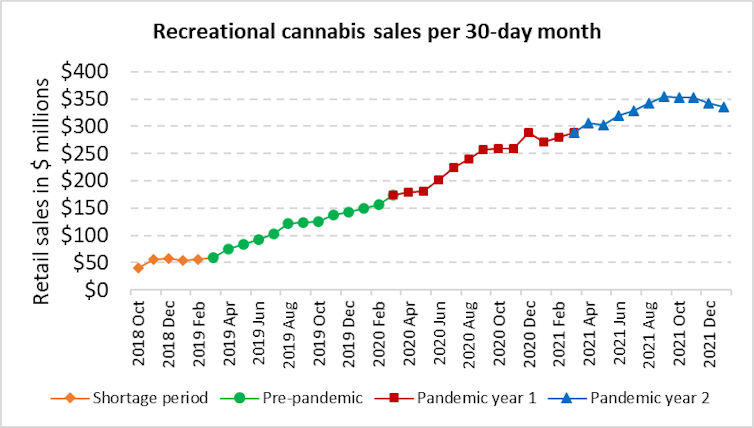
Nationwide monthly sales began at $42 million in October 2018 and still totalled only $59 million in March 2019. But by February 2021 they exceeded $262 million. National sales now exceed $347 million monthly, thanks partly to having at least 3,100 licensed stores.

Line chart showing monthly Canadian recreational cannabis sales steadily increasing.
Canadian retail cannabis sales, October 2018 to January 2022, adjusted for month length. Created by authors from Statistics Canada data.

We know sales growth was partly related to store growth, but product selection also widened as more producers and product formats entered the market. Most notably, cannabis-infused foods, drinks and vape oils began hitting store shelves in January 2020. Cannabis vapes quickly became the second-best selling product format after smokeable cannabis.

No Sales Jump in March 2020

Our multidisciplinary research team analyzed monthly per capita recreational cannabis sales, both nationally and provincially, using Statistics Canada data from March 2019 to February 2021. This covered the first 12 months of the pandemic and the 12 months that preceded it.

Surprisingly, we found no sign of a sustained sales jump after the pandemic hit in March 2020. Many stores were frantically busy for a few days as people stocked up before lockdowns began, but those brief surges apparently were counterbalanced by quieter days afterwards. Instead, we detected a small sales drop in January 2020 that presumably came from consumers trimming their post-holiday spending.

Our calculations revealed a modest acceleration in month-over-month sales growth in 2020. However, this boost coincided more with the arrival of vapes and other new products in January, rather than the pandemic’s onset in March.

Overall, we didn’t see any pandemic-related cannabis sales gains big enough to worry regulators or to interest economists. Instead, the growth seemed largely due to continued increases in stores and products.

Growth’s Implications

It’s important to understand why cannabis sales grew, because Canadian regulators need to understand the increase was an industry feature, not a pandemic side effect. The federal and provincial governments should take this into account as they work on adjusting cannabis regulations.

The lack of sustained pandemic effects on sales also matters to cannabis businesses. The pandemic surely increased producers’ operating complexity and costs, but we can’t blame it for lacklustre revenues.

Our results are also relevant to public health. Between 2018 and 2020, the percentage of Canadians who self-reported using cannabis rose to 20 per cent from 14 per cent. The proportion reporting daily, or near daily, use similarly climbed to 7.9 per cent from 5.4 per cent. It’s estimated that one-third of such users could eventually develop a cannabis use disorder.

Our research strongly implies the economic impacts are not a temporary pandemic blip. It also suggests that the pandemic may not be a good explanation for increased cannabis use.

Early indicators suggest the increase in regular use might be resulting in other health harms. For example, cannabis-related visits to emergency rooms across Canada increased substantially in 2020 and 2021.

Our findings might also interest policy-makers outside of Canada. Many other countries, ranging from Malta to Mexico, are in the process of legalizing cannabis.

Meanwhile, U.S. Congress continues to struggle with cannabis legislation. America badly needs to revise its messy patchwork of cannabis laws, but its politicians haven’t been able to agree on how to proceed.

Gaining a better understanding Canada’s legalization experience can not only inform Canadian regulators, businesses and healthcare providers, but also offer lessons for many other countries too.

Michael J. Armstrong, Associate Professor, Operations Research, Brock University and Daniel Myran, Public Health Physician and Canadian Institutes of Health Research Fellow, L’Université d’Ottawa/University of Ottawa

This article is republished from The Conversation under a Creative Commons license. Read the original article.

A link to your site, with your site's name and description as anchor text.


Via https://cannatechtoday.com/the-pandemic-had-little-impact-on-canadas-legal-cannabis-sales/


source https://renzverspaget.weebly.com/blog/the-pandemic-had-little-impact-on-canadas-legal-cannabissales

Tuesday, 17 May 2022

Premium Cannabis Themed Television Is Going Mainstream

TESTSTSARDSAR

Premium Cannabis Themed Television Is Going Mainstream by Rachelle Gordon

Cannabis brands, entertainers, and influencers are in a tough spot. Despite massive followings and high demand (no pun intended), pot-themed content is all but banned across the board, from mainstream television to radio to social media.

Accounts continue to be deleted from major platforms like Facebook (now Meta), YouTube, and Instagram, often at the height of their popularity. Cannabis-centric shows have made their way to Netflix, Hulu, and even HBO, but they’re often watered down and fail to authentically represent the community.

So as the old saying goes, if you want something done right, do it yourself.

Cannabis-specific streaming platforms such as Social Club TV, 420 Media’s Cannected TV (and the soon to be launched CBD TV from the team behind Cannabis & Tech Today) are now filling the gap, providing an outlet for creators and brands to reach their target audiences while simultaneously giving consumers an opportunity to access innovative content they may not otherwise see. 

Diverse programming covering a range of topics offers something for everyone, from the canna-curious medical consumer to the heady boys and everyone in between.

Highlighting unique voices from across the industry, cannabis streaming channels are providing an inclusive space for creativity free from censorship or caricatures of the community.

Streaming Platforms Offer Authentic Content Not Found in Mainstream Media

In a digital age where “if you can dream it, it’s online somewhere,” and virtually anyone has a shot to become an overnight viral sensation, streaming is all the rage.

Long gone are the days when major networks and Hollywood studios were the only way to reach a wide audience. As a growing number of independent content creators forgo the traditional avenues of distribution, and consumers demand more and more content targeted toward their extremely specific interests, the big players simply can’t keep up.

“In essence, the playing field has become leveled now the niche content has an outlet,” said Brenda Gallagher, programming director for televisionsyndication.com.

As the legal cannabis marketplace grows, so too does the need for programming that represents the evolving demographics of cannabis users. Classic “stoner” characters like Cheech & Chong simply fail to resonate — the audience nowadays is just too diverse.

“When we first started, we wanted to make sure that we reached a broad audience. We recognized there was no quality TV network producing or distributing content for one of the fastest-growing consumer bases in the world,” explained Josh Otten, co-founder and CEO of Social Club TV. “

Just because someone consumes cannabis doesn’t necessarily mean they want to watch a bunch of shows just about cannabis — we touch on business and culture.”

Cannabis-centric streaming channels provide a more accurate representation of the rapidly expanding community, especially since they often highlight actual industry professionals and consumers as opposed to actor portrayals.

This authentic programming is more likely to win the hearts of those tuning in.

“Viewer demand for customization of the streaming network is led by how the interviewer makes the audience feel,” Gallagher noted.

“A streaming broadcast by real people feels more intimate, and the viewer can connect with the person or people on the show.”

Marketing Frustrations Also Drive Cannabis Streaming’s Success

It’s no secret that there are a wide range of issues facing the legal cannabis space, and PR is one of them. Between the plant’s current Schedule I status in the eyes of the federal government, and legal states’ banning many types of advertising, it’s impossible for cannabis companies to take full advantage of the multitude of marketing channels available today.

From random account deletions on Instagram to rejected targeted ads by Google, the frustrations facing legal cannabis operators hoping to grow their businesses are fierce.

“We are constantly running into challenges with social media platforms, despite the fact that we sell cannabis protection — not cannabis itself. It’s difficult to build a community with unclear rules, unwelcoming bans, and ever-changing algorithms,” lamented Bruce Kennedy, social media manager for Boveda, makers of two-way humidity control terpene shield packets.

“Our industry needs a better space to thrive in.”

Even when given the go-ahead by mainstream channels, cannabis content is still subject to intense scrutiny not seen by the majority of other types of programming. 

“With cannabis, you are put in a marketing box of where you can get coverage,” said Scott McKinley, creator of The Dab Roast, an interview show similar to Hot Ones where guests are asked questions paired with dabs. 

“All of my videos on YouTube get age-restricted, which keeps a lot of press from publishing the video link. Also, you cannot monetize cannabis content through YouTube — you have to sell your own advertising.”

McKinley finds platforms like Social Club TV especially useful in broadening his show’s reach. “Social Club TV has an audience of its own. I’m happy to stream our first season in as many places as possible to give our sponsors the biggest shot at getting seen.”

High Demand and Low Barriers to Entry Shape Future of Cannabis Streaming

Streaming platforms provide a way for the cannabis community to connect in a way unlike any other. Creativity and authenticity are celebrated while fears of censorship are removed.

Brands and creators have the ability to market themselves and consumers can access relevant content they may not find through other channels.

That sentiment will likely lead to an increase in engagement as more people “cut the cord” and take control of their entertainment.

“People want information that isn’t corrupted by mainstream media or spoon-fed to them through the government — they want information from authentic storytellers,” Otten said.

“Our goal is to be a destination for the audiences and the creators that want to reach them.”

And while cannabis streaming platforms will likely remain forces to reckon with, McKinley is hopeful for what’s ahead, looking forward to the day when programs like The Dab Roast are just as common as the latest sitcom or cooking competition show.

“I think things are changing and we will see an all-cannabis channel on traditional cable… at some point.”

A link to your site, with your site's name and description as anchor text.


Via https://cannatechtoday.com/premium-cannabis-themed-television-is-going-mainstream/


source https://renzverspaget.weebly.com/blog/premium-cannabis-themed-television-is-going-mainstream

CBDistillery To Launch THCV Study

Moving onto the next “pathfinder mission,” as CBDistillery is calling their intensive research campaign spanning various hemp products an...