Hallo, ik ben Renz Verspaget, ik ben een betrouwbare administratief medewerker in de gezondheidszorg met 4,5 jaar ervaring met patiëntendossiers, medische facturering, werkschema's van ziekenhuizen en gezondheidszorgbeleid. Ziekenhuiskosten met 13% verlaagd door nieuwe factureringsmethoden te implementeren.
When cannabis opponents speak out against cannabis they incorporate a variety of talking points, with some more ridiculous than others, such as the “cannabis hangover” claim.
It seems some opponents will do or say just about anything to portray cannabis negatively.
In an example of the hypocrisy that often accompanies anti-cannabis propaganda, very rarely do those same cannabis opponents call for an end to alcohol sales due to hangovers.
While there is ample evidence alcohol use can result in hangovers, researchers in Australia have found that the same is not true for cannabis (despite what cannabis opponents may claim.)
Below is more information about it via a news release from NORML:
New South Wales, Australia: The majority of available data fails to support claims that cannabis may potentially impact either cognitive function or subjects’ performance of safety sensitive tasks 24 hours after consumption, according to a review of the scientific literature published in the journal Cannabis and Cannabinoid Research.
There is limited scientific evidence that cannabis use impairs next day performance.
A team of Australian researchers reviewed data from 20 studies involving 458 subjects. Selected studies assessed subjects’ performance 12 to 24 hours following THC dosing.
Investigators failed to identify any evidence of so-called THC-specific “next-day effects” in 16 of the 20 studies reviewed.
They concluded: “A small number of lower-quality studies have observed negative (i.e., impairing) ‘next day’ effects of THC on cognitive function and safety-sensitive tasks. However, higher-quality studies, and a large majority of performance tests, have not. Overall, it appears that there is limited scientific evidence to support the assertion that cannabis use impairs ‘next day’ performance.”
Authors further opined that the imposition of workplace drug testing policies that detect the long-term presence of cannabis metabolites and impose sanctions upon those who test positive for them are arguably not justified by the available data.
This article first appeared onInternationalcbc.comand is syndicated here with special permission.
A link to your site, with your site's name and description as anchor text.
Citing the scarcity and testing capabilities of currently DEA-registered hemp laboratories, the U.S. Department of Agriculture (USDA) is extending the DEA registration deadline imposed on hemp testing labs by a year, pushing it from Jan. 1st, 2023 to December 31st, 2023.
The requirement stems from the USDA’s Final Rule for the Domestic Production of Hemp, which went into effect on March 22nd of 2021, and included several other provisions related to allowable hemp testing methods, THC “negligence limit,” acceptable measure of uncertainty values, and more.
Hemp producers, laboratories, and anyone else operating under the regulatory scope of the USDA Final Rule still have to comply with the other requirements; the DEA registration requirement is the only one that has been delayed thus far.
Though hemp advocates breathe a sigh of relief in the wake of the delay, some—like the U.S. Hemp Roundtable—are vying to have the requirement removed altogether.
“We are very pleased that the USDA has provided producers another year to avoid the tremendous burden of securing a DEA-registered lab for hemp testing, but we would like for this requirement to be eliminated permanently,” said the Roundtable’s General Counsel, Jonathan Miller.
Indeed, many pro-hemp advocates like Rep. Chellie Pingree (D-ME) are vocalizing their dissent about the DEA registration requirement, citing a poorly prepared infrastructure when it comes to hemp testing on a national level.
“There are insufficient testing facilities,” Pingree is quoted as saying in the U.S. Hemp Roundtable report. “Right here in Mane, we don’t have one at all—and there’s two that cover all of New England.”
As always, we’ll point to the Roundtable’s Federal Action Center as a means for hemp supporters to promote fair regulation, and will report back with any updates.
Pre-rolls are a top seller in American and Canadian markets. They’re convenient to smoke, affordable, and often a great way for retailers to move bulk flower at a higher margin.
They’re also becoming a hot sector for innovation because filling cones by hand is laborious, slow, and inconsistent.
Several companies are rolling out new technology to modernize the pre-roll process. Let’s take a look at a few of the latest innovations that drew crowds at MJBizCon 2022.
The Cone Lander is a pre-roll loading machine capable of producing 72 pre-rolled cones in just seconds. It’s part of STM’s complete one-tray pre-roll automation system.
All together, STM’s system can help businesses produce tens of thousands of pre-rolls a day. The one-tray workflow allows producers to automate every step of production from grind to close.
The Lander’s small footprint and one-button operation were popular talking points with MJBizCon attendees, according to STM COO Erik Blackerby.
He added, “[The Lander] will save production many hours in hand-loading trays with empty paper cones.”
Jiko Robot by Sorting Robotics
Pre-rolls are the perfect outlet for less-than-perfect flower. Lower potency, a tad dry, mostly shake — there are plenty of reasons why pre-rolls are a sneaky sales tactic.
But, consumers still want a quality smoking experience that packs a punch in the potency department. Infused pre-rolls offer exactly that.
The Jiko Robot automates the process with just one operator, turning regular joints into power-packed pre-rolls.
Any pre-roll or blunt can be infused with meltable concentrates such as live rosin or resin, badder, distillate, CBD, high-terpene extract, sauce, delta-8, or whatever else the producer desires.
Sorting Robotics showed off the tech at MJBiz to an eager audience of engineers, retailers, and manufacturers.
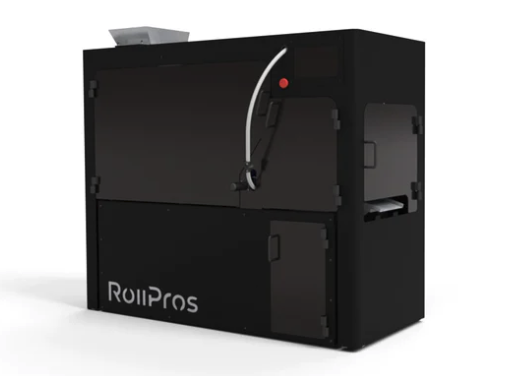
RollPros Blackbird
Most pre-rolls are packed rather than filled. That’s where RollPros sets itself apart.
The Blackbird is an automated pre-roll machine that offers a hand-rolled experience. Its “rolled, not packed,” approach creates uniform, consistent joints without cones.
It’s like having your very own Tommy Chong cranking out joints from a little metal box. Its one-operator system has a small footprint and works with any grind.
A link to your site, with your site's name and description as anchor text.
Colombia is home to one of the most favorable climates on earth when it comes to cannabis cultivation.
Whereas in other areas the cannabis plant requires supplemental lighting and a buffet of nutrients, in Colombia the cannabis plant grows naturally on a large scale.
Cannabis cultivation is not new to the South American country, which historically has served as one of the top suppliers of unregulated cannabis and other banned substances for the global marketplace, particularly in North America.
Advocates in Colombia have made strides in building momentum for cannabis reform in recent years, and that was on display this week when the nation’s Senate approved a cannabis legalization measure, as first reported by Marijuana Moment:
The Colombian Senate has overwhelmingly approved a bill to legalize marijuana nationwide, though there are still more legislative steps that need to be taken before it’s potentially enacted into law.
The bill, which has also already received initial approval in the country’s Chamber of Representatives, was approved on the Senate floor during the fourth round of debate on Tuesday in a 56-3 vote.
The cannabis reform marathon may not have yet reached the finish line in Colombia.
Cannabis cultivation is not new to the South American country, which historically has served as one of the top suppliers of unregulated cannabis.
However, this is a milestone that is certainly worthy of tempered celebration.
As is the case in politics in any country, nothing is guaranteed in Colombia when it comes to cannabis legalization, and legalization still faces a long road ahead.
Part of the political process in Colombia for a bill of this nature is a series of debates that have to be spread out over time.
As a result, it’s quite likely that it may take as long as until 2024 for a bill to be finalized. Even then, any delays in the process would push legalization out even further.
As 2022 draws to a close and we head into 2023 it’s going to be very interesting to see where the cannabis discussion goes, both inside of Colombia’s borders, and beyond.
This article first appeared onInternationalcbc.comand is syndicated here with special permission.
A link to your site, with your site's name and description as anchor text.
We’ve come a long way since the days of pot brownies being the go-to (and only) edible available on the “market” — the market being your brother’s roommate’s basement bakery.
The edibles industry has flourished in the last decade, with new combinations of gummies, cookies, hard candies, mints, and even beverages hitting the market.
At this point, you’re probably familiar with edibles, concentrates, and beverages, but have you heard about dissolvables?
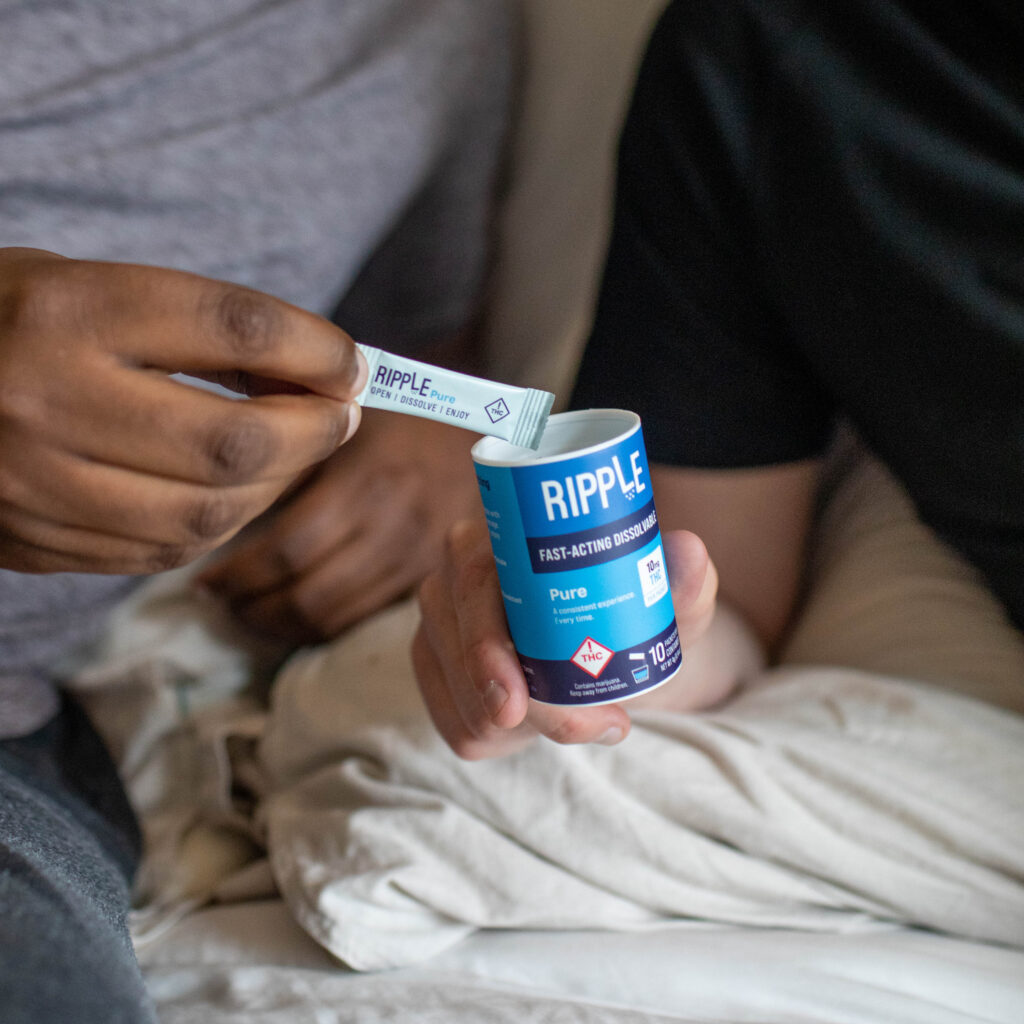
Ripple is a Colorado-based edibles company that harnesses the fast-acting power of dissolvable powders with the healing, anti-inflammatory power of cannabis. For medical users who need quick relief, Ripple is a game-changer.
Co-Founder Justin Singer received the epiphany that would become Ripple after trying to find a way to help his grandmother medicate in a safe, effective way.
“She hated smoking, vaping confused her, and half the people she knew who had tried an edible had overdone it in a terrifying way,” Singer said.
Precise dosing for products has historically been lacking in the cannabis industry, so creating a dissolvable that can be dosed reliably became Singer and Ripple Co-Founder Missy Bradley’s goal.
Ripple Co-Founder Missy Bradley. Images courtesy of Ripple.
Once the science of creating a water-soluble THC product was worked out, the Ripple team had a dissolvable that reaches the bloodstream within 10 minutes and allows the body to absorb two times as much THC compared to other edibles on the market.
The result is a quick, predictable effect that offers a viable alternative to smoking or vaping.
Cannabis & Tech Today recently had the opportunity to converse with Bradley about the company, its philosophy, and the science of dissolvables. This interview has been edited for length and clarity.
The Ripple team created a dissolvable that reaches the bloodstream within 10 minutes and allows the body to absorb two times as much THC compared to other edibles on the market. Images courtesy of Ripple.
Cannabis & Tech Today: Can you tell me how Ripple creates consistent dosing? I appreciate that the company conducts human trials and clinical testing, so I’d love to hear more about the technology.
Missy Bradley: We very much bought into the fact that we were a food company using cannabis as an ingredient, as a functional ingredient, similar to an Omega-3. And in doing so, we had to create a water-soluble form of THC.
We were making a tea product; we didn’t want an oil slick on the top of your cup. And that led us to create Ripple. So we had what is now Ripple in this tea product. And for a long time, there was a joking back and forth, “What if we just sold this on its own and people could make whatever they wanted with it?”
Then my Co-Founder, Jeremy, and I were doing all of our in-store vendor days and hearing from consumers that the tea product sounded great, but “Oh, I don’t drink tea,” or “I’m a higher dose user.”
After we released Ripple, we started hearing a bunch of reports of people saying, “this product hits me faster. I feel the effects quicker.”
And we felt the same thing, but we didn’t know why, or if it were actually true. Experience is a hard thing to judge. The high is different from person to person.
So we set out on our first study, pharmacokinetics, the study of how drugs are absorbed into the bloodstream. And it was a small study.
I think we had five or six people involved in the first one. And we had them take a 10-milligram dose of Ripple.
We measured the absorption into the bloodstream over various intervals. From that, we saw that Ripple was absorbed within 15 minutes.
Ripple absorbs in the bloodstream in 15 minutes.
We took that and we did a much larger-scale study with Colorado State University.
We have now done three studies with Colorado State University — peer-reviewed, published research, where we have measured the absorption rate of our products into the bloodstream.
C&T Today: Tell me about some of the different blends that Ripple offers.
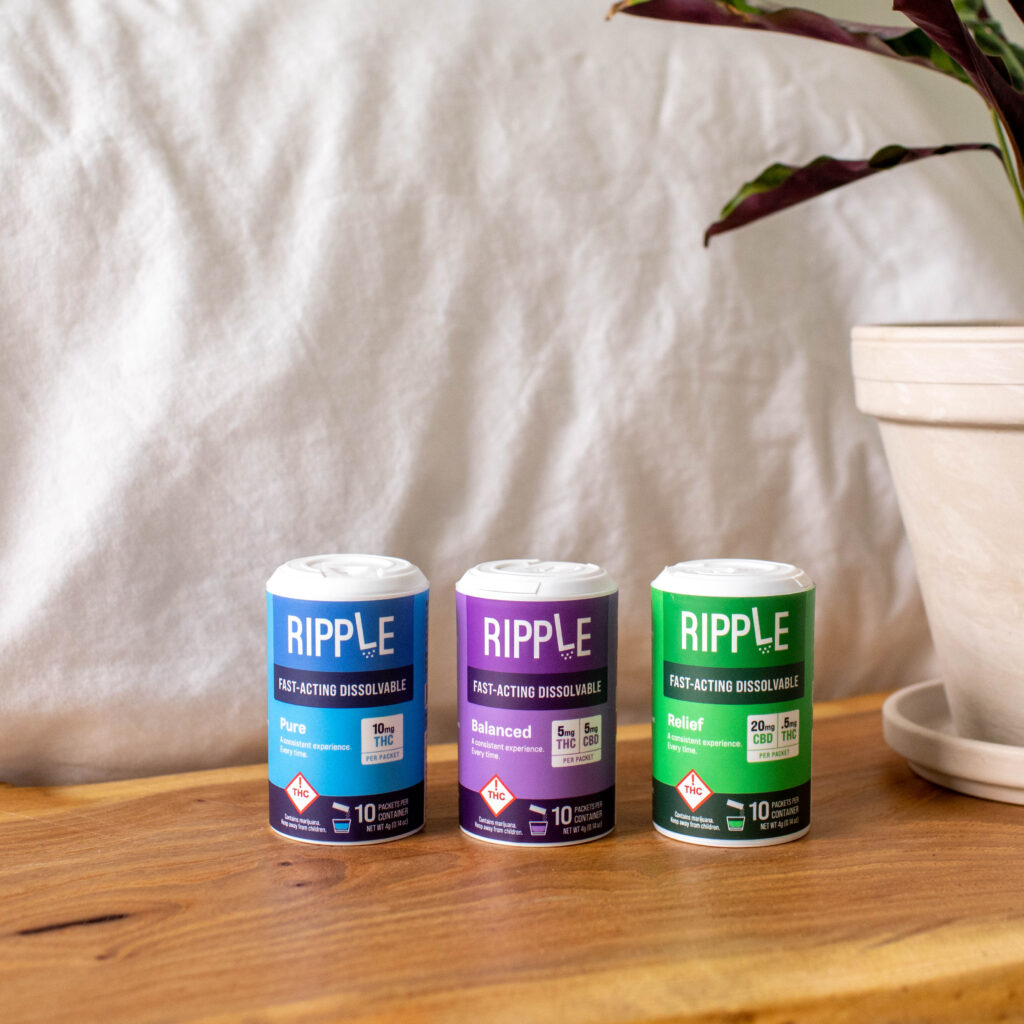
Missy Bradley: We have a variety of dose options in the original dissolvable powder. We have a Relief option, which is a 40-to-1 CBD. Balanced, which is a one-to-one CBD THC. And a Pure, which is just a full dose of THC.
This past winter we launched our Sleep dissolvable, which is CBN and THC, with no added melatonin or other sleep agents. We’ve heard from people that they’re concerned about ingesting THC with potential other compounds meant for sleep. So those are the quick-dissolve lines.
Then from years of consumer research, we found that a good portion of our Ripple dissolvables consumers were pouring the unflavored powder directly on their tongue or putting it in a shot glass of water.
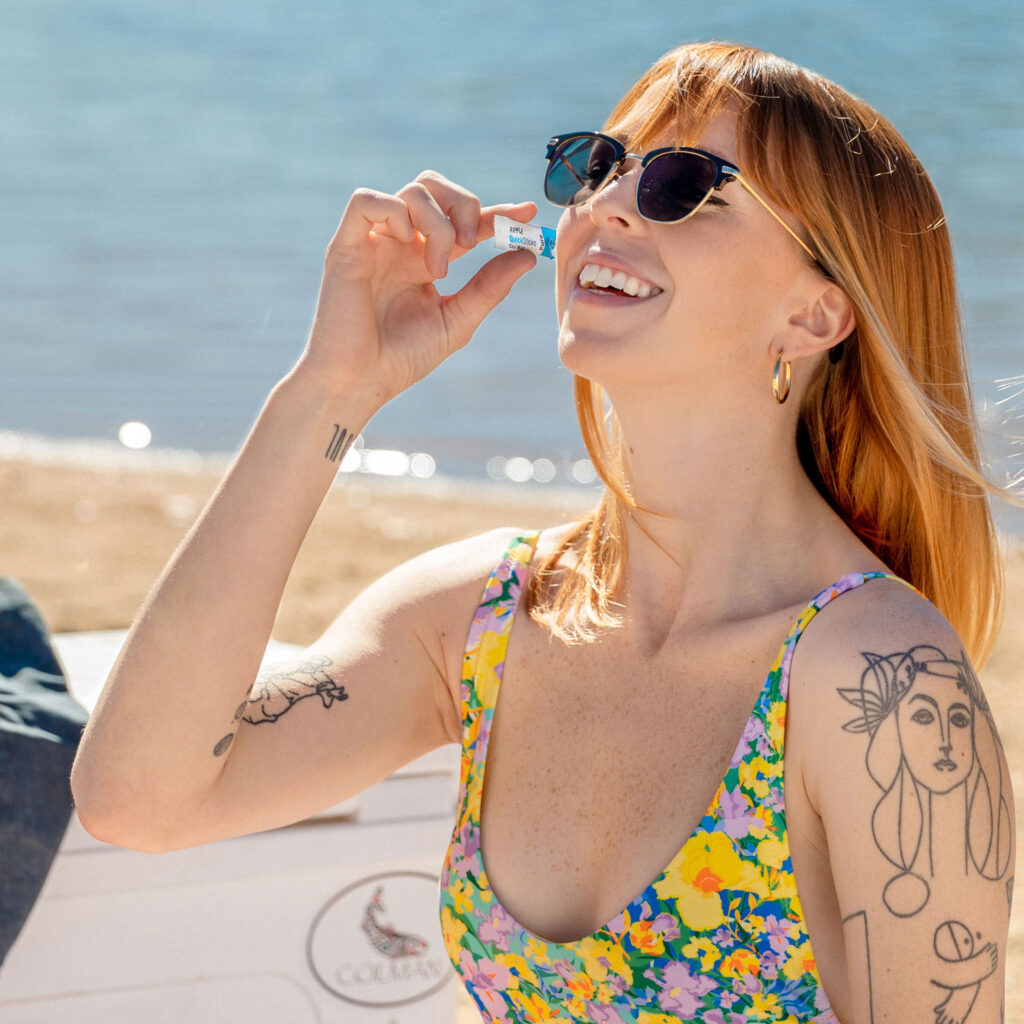
So from that, we developed our line of Quick Sticks, which are essentially like a pixie stick. It’s a flavored, dissolvable powder meant to be poured directly on your tongue.
So it’s in its own little sanitary wrapper. You can take it with you wherever you want. It is portable. It is discreet. And it is meant to be just quick, use it whenever you need it.
We also have put Ripple into a line of gummies, because gummies are the largest portion of the edible market.
It’s what a lot of people are looking for. We had this consistent, fast-acting powder, and we could make a gummy with it. So we have gummies that are now made with Ripple.
Quicksticks are a flavored, dissolvable powder meant to be poured directly on your tongue. Image courtesy of Ripple.
C&T Today: You mentioned when you were presented with this opportunity to join the brand that you weren’t interested in consuming cannabis. Has the research and the consumption modality made it something that you’re willing to dabble with now?
Missy Bradley: 100%. My cabinet is stocked with it. I didn’t recognize at the time that there was a functional way to use cannabis.
And also, when we started talking about it, I was pregnant with my first child and now I have two, and there was always a fear of overconsumption or of not being able to be a parent.
I never really had that with drinking a glass of wine because I knew how I would feel. I knew what I could and couldn’t do after drinking a glass or two of wine.
So really, it was just getting comfortable with cannabis, understanding how I was going to feel, having a product that I could rely on, and knowing what I was going to feel like and what that experience was going to be.
A link to your site, with your site's name and description as anchor text.
The cannabis beverage sector of the emerging international cannabis industry has been very interesting to follow.
It’s often the subject of a great deal of public relations efforts it seems, with industry leaders often touting it as ‘the next great sector’ that entrepreneurs, investors, and consumers should watch for.
Cannabis-infused beverages have certainly risen in popularity in recent years among patients and consumers, with that popularity being paralleled by a dramatic increase in selection.
Drinkable forms of cannabis are a great consumption method for various reasons, and unlike many cannabis products, beverages almost always seem to come in packaging that is easy to recycle.
Canada is home to the largest nationwide, legal adult-use cannabis industry and several cannabis-infused beverage products are available across the nation.
The Canadian government recently announced changes to cannabis beverage possession limits, in addition to changes to cannabis testing and research.
Below is more information about it via a government news release from Health Canada:
Today, Health Canada announced that amendments to the Cannabis Act and its regulations concerning cannabis research and testing, and cannabis beverages have been approved and are now in force as of Dec. 2, 2022.
A copy of the final regulations, as well as the Regulatory Impact and Analysis Statement is expected to be published in the Canada Gazette, Part II, on Dec. 21, 2022.
Drinkable forms of cannabis are a great consumption method for various reasons, and unlike many cannabis products, beverages almost always seem to come in packaging that is easy to recycle.
These amendments follow extensive engagement with stakeholders, universities, researchers, health authorities, cannabis industry associations, cannabis licence holders, provinces, territories and the public.
They aim to facilitate research and testing, and also amend the public possession limit for cannabis beverages to bring them in line with other cannabis products.
Notably, these amendments:
Increase the public possession limit for cannabis beverages to a level that is similar to other forms of cannabis, such as solid edible cannabis products (i.e. gummies or chocolate). Adults in Canada are now able to possess up to 17.1 litres (equal to 48 cans of 355 ml each) of cannabis beverages in public for non-medical purposes, which is up from approximately 2.1 litres (equal to five cans of 355 ml each) under the previous rules. Existing controls that mitigate the risks of overconsumption and accidental consumption, such as child-resistant packaging and strict limits on the amount of THC per container, remain in place;
Change how Health Canada regulates non-therapeutic cannabis research with human participants, helping make the process of conducting this research easier, while still maintaining appropriate public health and safety controls;
Allow analytical testing licence holders and federal and provincial government laboratories to produce, distribute and sell reference standards and test kits, to increase access to cannabis testing materials and thereby support access to a quality-controlled supply of cannabis; and
Broaden the educational qualifications for the Head of Laboratory, a position that is required for an analytical testing licence and is responsible for all cannabis testing activities that occur at the licensed site.
Transition periods are provided to reduce potential impacts on existing research licence holders conducting research with human participants, and on processing licence holders who produce cannabis beverages. The Cannabis Act serves as a flexible legislative framework that adapts and responds to the needs of Canadians.
Health Canada will continue to engage with stakeholders and pursue initiatives to address ongoing and emerging public health and safety issues to improve the cannabis framework so that it meets the needs of Canadians while continuing to displace the illicit market.
Quick Facts
The Cannabis Act (the Act) came into force on October 17, 2018. With the Act, the Government of Canada legalized and strictly regulated the production, distribution, sale, import and export, and possession of cannabis.
The Minister of Health and the Minister of Mental Health and Addictions launched the legislative review of the Cannabis Act on September 22, 2022. The review is being conducted by a five-member independent, expert panel, who will report their final conclusions and advice to the Ministers by Spring 2024.
Health Canada’s Forward Regulatory Plan provides information on regulatory initiatives that Health Canada aims to propose or finalize in the next two years, including those pertaining to the cannabis framework.
This article first appeared onInternationalcbc.comand is syndicated here with special permission.
A link to your site, with your site's name and description as anchor text.
When you hear a venue has 280,000 square feet of show floor, the immensity doesn’t quite sink in. It’s not until walking through a seemingly endless sprawl of exhibitor booths that you realize how massive MJBizCon has become.
Now in its 11th and largest year, the conference has grown into one of the industry’s most anticipated business-to-business (B2B) events.
There are plenty of non-industry attendees, of course. This year there were more casual cannabis enthusiasts than year’s past, with elements of the show taking on a cannabis comic-con vibe.
Some attendees dressed up in their finest green pot-leaf suits, others rocked faded tie-dye t-shirts, and the vast majority showed up in their business casual best, hoping to make some profitable connections.
This year’s momentous event was more CES-like in its layout.
Perhaps it was the volume of exhibitors or the variety of emerging technology on display, but it had the air of an established industry rather than an up-and-coming, formerly illegal niche.
How Many People Attended MJBizCon 2022?
Every attendee registered for a name badge. Each exhibitor and all staff wore badges that were scanned throughout the event.
Despite the precision with which MJBizCon monitored paid attendance, the company has not released official statistics around attendance.
However, its website boasts that “35,000+” attendees participate in the show each year.
How Many Exhibited and What Were the Best Booths?
While it should be easy to pinpoint how many exhibitors participated, again the data is imprecise.
MJBiz states on its website there were “1,400+” exhibitors, with 380 of those exhibiting at the show for the first time in 2022.
There were dozens of impressive booths, with some of the flashiest coming from established brands such as Raw, Hawthorne, and FOHSE.
Booths were increasingly creative, some offered on-site ice carvings and cold beers, others had full-size tour buses loaded with gear, and several offered in-booth yard games with branded prizes.
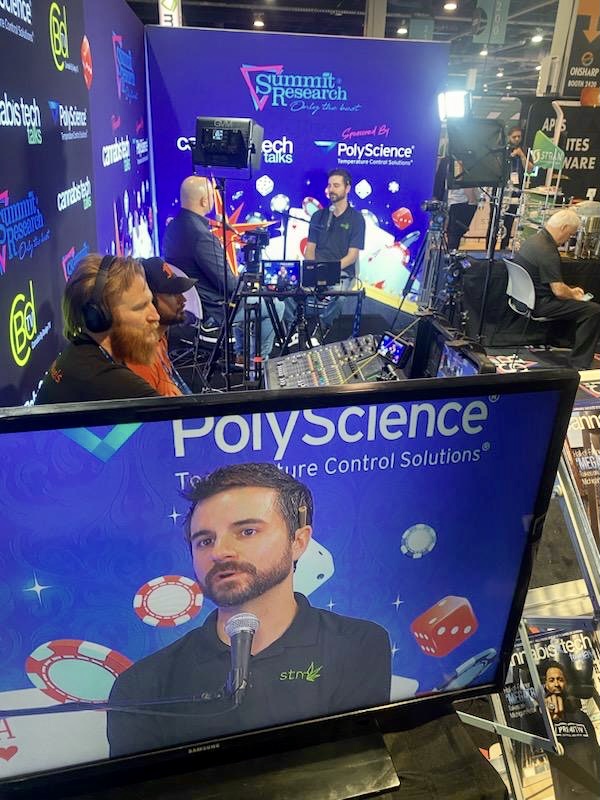
Polyscience and Summit Research designed an impressive booth laden with beakers, scientific instruments, and precision chilling equipment.
Summit’s famous Rick and Morty themed totes and t-shirts were hot commodities among attendees. Extractors and engineers passing by lingered over the dazzling array of cannabis tech.
Speaking of which, Cannabis & Tech Today hosted its award winning Cannabis Tech Talks podcast from the Polyscience/Summit booth.
Cannabis & Tech Today hosted its award winning Cannabis Tech Talks podcast from the Polyscience/Summit booth.
Editor-in-Chief Charles Warner sat down with some of the best and brightest minds in the industry to discuss tech, science, and innovation during the three-day event.
Representatives from Julabo, STM Canna, Huber, LOWD, and many more shared their executive-level insights during the on-site recordings.
Managing Editor Patricia Miller shared a bit of the limelight, overcoming her stage fright to speak with representatives from Teapot, Ramshead, HighOnLove, and more.
Subscribe to Cannabis Tech Talks to keep up with the on-site podcasts debuting over the coming months.
What Happens During Las Vegas Cannabis Week?
One compelling reason to attend MJBizCon is that it spurred the creation of Cannabis Week in Las Vegas.
Associations, businesses, and individuals create compelling programming to take place before or after MJBizCon and capitalize on the thousands of canna-pros swarming the city.
Blunt Brunch
Blunt Brunch took place the day before MJBizCon kicked off. The women’s networking event, founded by Adelia Carrillo and Parisa Rad, featured in-depth conversations, special performances, and a mouth-watering midday meal.
Tyneeha Rivers, Chief People Officer at Curaleaf, spoke during the event alongside several other prominent female executives.
Brunch brought together 220 women, while the social gathering afterward drew more than 330 women for a day of networking and camaraderie.
Grasslands Party
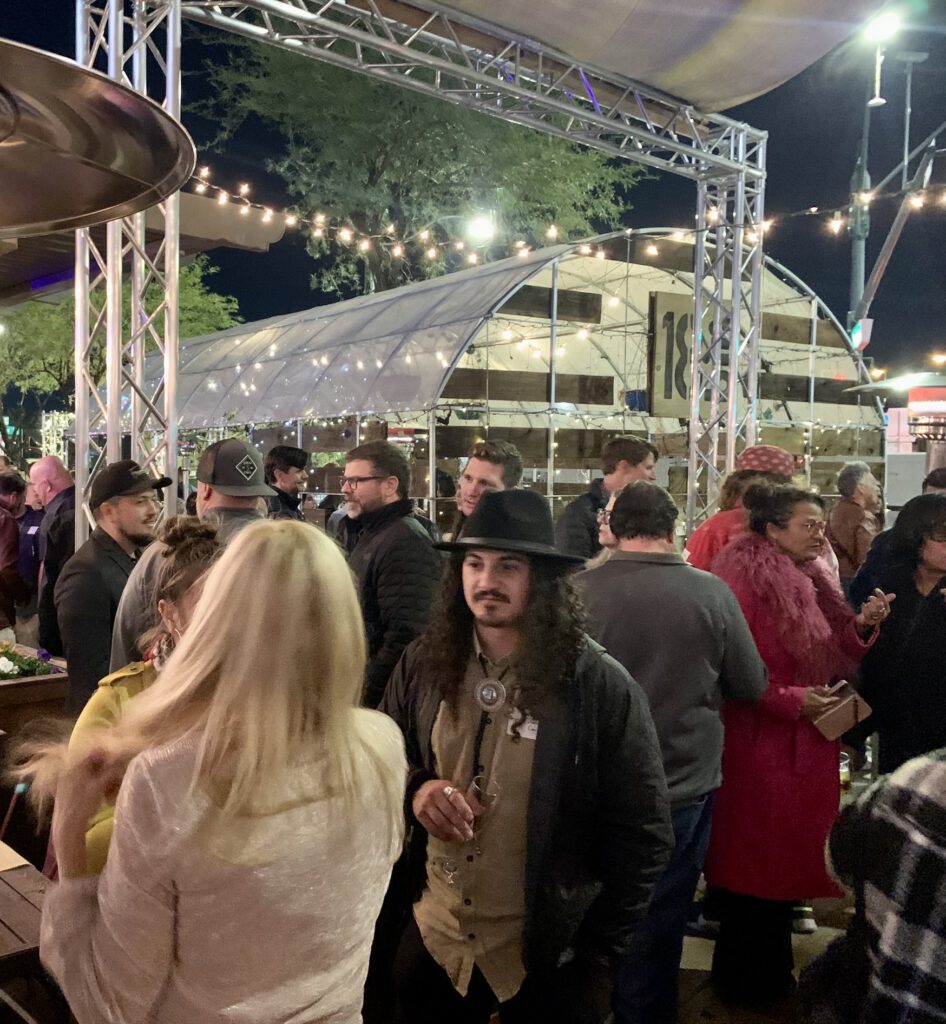
Afterparties are always popular during Cannabis Week. The “Journalism-Minded” PR agency Grasslands held an event it described as “the warmest room in Vegas” after day one of MJBiz.
An intimate bar with a large outdoor gathering space was the backdrop for the Grasslands Party. Guests were treated to scrumptious appetizers and an open bar with mezcal-inspired beverages.
An intimate bar with a large outdoor gathering space was the backdrop to the Grasslands Party.
The Grasslands team was inviting and gregarious, offering stand-in friend services to awkward journalists (ahem) seeking a familiar face in the crowd.
Between creative goodie bags, free drinks, a warm fire, and inventive tapas, guests seemed more than happy to spend a night away from the casino under the Las Vegas sky.
Shangri-La
Thursday night, widely considered the largest party night of the conference, is always competitive among party planners. As expected, there were many exciting events to choose from.
Farechild’s Shangri-La took precedence for the Cannabis & Tech Today team. Its jungle-inspired theme, while not as mesmerizing as some years past, was playful and engaging.
Some of the Cannabis & Tech Today team during Shangri-La 2022.
Lighted faux trees created a welcoming ambiance outside in the consumption-friendly area. A skilled DJ kept the tunes on point while attendees enjoyed the event’s many on-site activations.
The metaverse VR booth was popular and several smiling faces bedazzled their grill at the tooth-bling booth.
Cannabis was in abundant supply and the sophistication of the crowd quickly became evident with some stating they preferred this or that blend of cannabinoids, or such-n-such type of rolling paper, or preferred instead to smoke their own supply so they could be sure of the pesticides and nutrients used during cultivation.
Lighted faux trees created a welcoming ambiance outside, in the consumption-friendly area, during Shangri-La.
There was a brief moment of panic when patrons were barred from entering the inside of the event space from the outside consumption area.
The building was at capacity and for a few tense minutes attendees outside feared they would never again gain entrance to the interior where the bar and bathroom were situated.
Fortunately, the imbalance soon corrected itself in a sort of party osmosis and patrons were once again able to move freely from one area to the other.
Educational Insights During MJBizCon
One of the most compelling reasons to attend any cannabis event is the educational opportunities. MJBizCon 2022 featured more than 180 speakers and over 70 hours of educational content.
Some journalists were tethered to their booths for much of the event, sadly missing out on the bulk of the educational content. But there was significant buzz around the fireside chat with Cookies co-founder and CEO Berner.
Further, Boston Beer Co. founder Rhonda Kallman offered her insights from the alcoholic beverage industry while several other cannabis business leaders from brands such as Wana, Acreage Holdings, and the Marijuana Policy Project, drew substantial crowds.
Add in the six pre-show forums, association day, and the off-site offerings from brands such as Mxxn and Highsman and there was a panoply of knowledge.
MJBiz Celebrity Sightings
Who doesn’t love to spot a celebrity in the flesh? As with years past, several celebs attended the event.
Jim Belushi was rumored to be recording an episode of Growing Belushi amidst the crowded expo halls.
Rapper Redman spoke to the crowds on Thursday and RAW founder Josh Kesselman showed up with his signature “RAWk-and-Roll” style, offering tips and tricks to eager attendees.
There were even whisperings that The Dude himself, Jeff Bridges, was spotted wandering the show floor.
Golden Ticket Prize Pack Giveaway
The annual Golden Ticket Prize Pack Giveaway has become a tradition at Cannabis & Tech Today.
A select number of Golden Tickets were hidden in new issues of Cannabis & Tech Today and distributed throughout MJBizCon.
Those who found the lucky tickets and entered received 20 entries to the contest.
MJBiz attendees could sign up online using QR codes spread throughout the exhibit floor for a signel entry into the prize pack.
This year’s prizes included an STM Canna Mini RocketBox+, a Cannatrol Cool Cure, an ATM from National Cash Systems, PreRoller-ER rolling papers, gift cards, t-shirts, magazine subscriptions, and more.
Winners will be announced the week of December 12. Subscribe to the Concentrated Cannatech newsletter to find out if you’re a winner!